US Hospitalization Data

HHS current hospitalization data is always available here:

https://protect-public.hhs.gov/pages/hospital-capacity

On 11/23/2020 it shows 60.62% ICU occupancy across the US (not just covid ICU).

[ UPDATE: 12/4/2020 shows 60.14% ICU occupancy ]

[ UPDATE: 12/9/2020 shows 63.57% ICU occupancy ]

[ UPDATE: 12/15/2020 shows 63.87% ICU occupancy ]

[ UPDATE: 12/29/2020 shows 61.15% ICU occupancy ]

[ UPDATE: 1/4/2020 shows 63.18% ICU occupancy ]

The map shows state by state breakdowns.

Check back often…

Note: You may also Google NY Times ICU occupancy to check your local stats.

https://www.nytimes.com/interactive/2020/us/covid-hospitals-near-you.html

However, the Times acquires their figures from the HHS. The HHS website link is provided above.

When I checked today the Times’ estimated national ICU occupancy figure (levels reported over the seven days from Dec. 4 through Dec. 10)

************

************

was 14.13% higher than HHS Data Hub’s national ICU occupancy.

(Perhaps one or the other has not recently updated.)

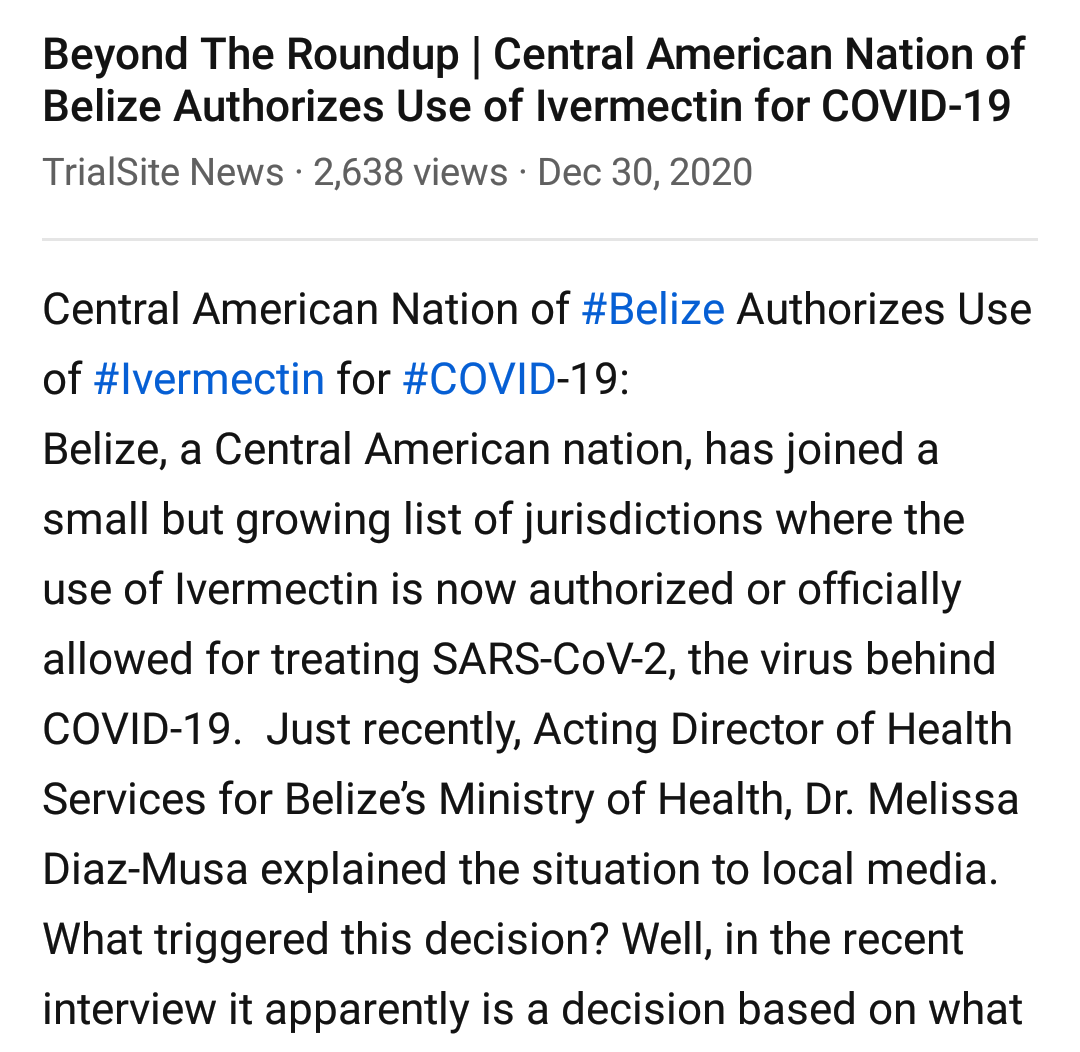
Covid Treatment with Antiparasitic Ivermectin

Youtube has censored this ivermectin video, but here are great interviews about it: https://projectwaistline.com/?p=25612

https://youtu.be/MEk-VOufVGQ

Dec 4, 2020

RESEARCH GROUP:

https://covid19criticalcare.com/

NOTE:

I just remembered this story last year of a man’s cancer going into remission using the de-wormer benzimidazole. http://projectwaistline.com/?p=17526

The ivermectin we’ve been discussing is described as a treatment for parasitic worms. ARE THESE TWO RELATED??

Here’s a 2016 paper describing the use of benzimidazole as an ANTIVIRAL.
https://jvi.asm.org/content/90/19/8422

EARLY OUTPATIENT COVID TREATMENT

https://youtube.com/watch?v=Tq8SXOBy-4w

10 minute 10 second video from Dec 8, 2020 discussing the positive outcomes using the repurposed drug Ivermectin (earned a Nobel Prize for treatment of parasitic diseases in 2015).

Here is a research paper published in June:

The FDA-approved drug ivermectin inhibits the replication of SARS-CoV-2 in vitro

2 hours 16 minute video (Senate hearing I, Nov 19, 2020 )

2 hours 40 minutes (Senate hearing II, Dec 8, 2020)

Senate considers early outpatient covid treatment.

Covid Vaccine Questions

On December 1, 2020

* Dr. Wolfgang Wodarg, chairman of the Health Committee of PACE (Parliamentary Assembly of the Council of Europe), medical doctor, epidemiologist, specialist in lung disease and environmental medicine

AND

* Dr. Michael Yeadon, PhD in respiratory pharmacology and a former leader in pharmaceutical corporations

filed an application with the EMA, the European Medicine Agency responsible for EU-wide drug approval, for the immediate suspension of all SARS CoV 2 vaccine studies, in particular the BioNtech/Pfizer study on BNT162b (EudraCT number 2020-002641-42).

For your consideration… we are as the Bereans. We will not walk blindly into the future. We will search, research & consider.

These were more noble than those in Thessalonica, in that they received the word with all readiness of mind, and searched the scriptures daily, whether those things were so.

(Acts 17:10,11)

Click here for reproductive questions

AND

Click here for social equity issues

Defining CFR, Case Fatality Rate (Dec 6, 2020)

In order to better understand CFR we consider definition in this link from Britannica.

Case fatality rate, also called case fatality risk or case fatality ratio, in epidemiology, the proportion of people who die from a specified disease among all individuals diagnosed with the disease over a certain period of time.

.

We take current stats from WORLDOMETER and apply the definition for a rough estimate:

Case Fatality Rate for USA

Actual Cases with an outcome as of Dec 9 = estimated actual recovered (9,088,387) + estimated actual deaths (293,496) = 9,381,883

Case Fatality Rate (CFR) = Deaths / Cases = 293,496 / 9,381,883 = 0.03128327223 = 3.1%

Our crude estimate shows that approximately 96.9% of people infected with SARS-CoV-2 recover (100% – 3.1% = 96.9%). Keep in mind covid deaths are very likely overstated, and covid cases are very likely underreported.

This calculation includes all cases, of all ages, with & without comorbidities.

Had we used the number of USA cases at WORLDOMETER, 15,607,655 as of Dec 9, our survival rate would look much higher: 293,496 / 15,607,655 = 0.019 = 1.9%, yielding a survival rate of 98.1%. But the 96.9% survival rate calculated above is a much more conservative figure.

Professor Discusses Covid-19

Dec 4, 2020

(English subtitles)

https://youtu.be/nO1uTHpPXRY

Suchrid Bhakdi studied at the Universities of Bonn, Gießen, Mainz and Copenhagen, and at the Max Planck Institute of Immunobiology and Epigenetics in Freiburg.

He studied medicine at the University of Bonn from 1963 to 1970, during part of which (from 1966 to 1970) he was a scholarship holder of the German Academic Exchange Service. Bhakdi worked for a while as a private assistant to the internal medicine specialist Walter Siegenthaler. In February 1971 he received his doctorate in medicine. From 1972 to 1974, he held a scholarship from the Max Planck Society at the Max Planck Institute of Immunobiology in Freiburg. From 1974 to 1976, he also received a scholarship from the Alexander von Humboldt Foundation at the Max Planck Institute for Immunobiology in Freiburg.

After a one-year stay at the University of Copenhagen, he worked from 1977 to 1990 at the Institute of Medical Microbiology at the Justus Liebig University in Gießen. In July 1979 he habilitated. He was appointed C2 professor in 1982 and C3 professor of medical microbiology in 1987 before being appointed to the University of Mainz in 1990. From 1991 he headed the Institute of Medical Microbiology and Hygiene as a C4 professor.

Bhakdi retired on 1 April 2012. Since 2016 he has been a visiting scholar at the University of Kiel.

One Of The Lockdowns’ Greatest Casualties Could Be Science

“Politicians, journalists, and scientists have transferred the disease burden onto the working class. They’ve also dangerously undermined scientific inquiry.”

This article was written by:

Dr. Martin Kulldorff

Dr. Jay Bhattacharya

The COVID-19 pandemic and lockdowns have not only been devastating for society, they have had a chilling effect on the scientific community. For science to thrive, opposing ideas must be openly and vigorously discussed, supported, or countered based on scientific merit.

Instead, some politicians, journalists, and (alas) scientists have engaged in vicious slander of dissident scientists, spreading damaging conspiracy theories, even with open calls for censorship in place of debate. In many cases, eminent scientific voices have been effectively silenced, often with gutter tactics. People who oppose lockdowns have been accused of having blood on their hands, their university positions threatened, with many of our colleagues choosing to stay quiet rather than face the mob.

We tell the story here of five prominent scientists who have faced the modern-day inquisition.

Dr. Scott Atlas

Dr. Scott Atlas served as a special advisor to the president on COVID policy between July and November 2020. This would be a difficult job in normal circumstances when the science is more mature.

With his background in public health policy, Atlas’s advice emphasized balancing risks imposed by viral spread against collateral public health harms from the lockdowns in a rapidly changing scientific and policy environment. Scientists who did not share his views had every opportunity to do so responsibly by reporting scientific facts and conjectures and engaging with his ideas.

Instead, the Journal of the American Medical Association—the flagship medical journal in the United States—published an opinion article defaming him without engaging his actual scientific views. The editors of the journal then refused to publish letters supporting Atlas.

Contrary to his critics, Atlas got the science right. The highest COVID-19 mortality risk is among nursing home residents. Atlas worked to ensure federal support for frequent and rapid testing of nursing home staff, residents, and visitors. While not implemented everywhere, this initiative alone saved innumerable lives.

Atlas worked hard to make masks available in nursing homes. Atlas was right to contradict former Centers for Disease Control director Dr. Robert Redfield’s false assertion that masks are more effective than vaccines. Atlas advocated for in-person schooling during the pandemic, a position that even pro-lockdown epidemiologists now endorse.

Dr. John Ioannidis

Dr. John Ioannidis is a world-famous scientist who from the beginning of the epidemic called for better scientific information to decide COVID policy. His work, published in the “Bulletin of the World Health Organization,” has helped establish how deadly the virus actually is—an order of magnitude lower than the conventional narrative implies. For his work, BuzzFeed News falsely accused him of political bias and financial conflicts of interest.

In two articles published in Scientific American, two esteemed medical journalists presented evidence against the false charges Ioannidis faced, while lamenting the slander of scientists as a substitute for scientific debate. Shockingly, these journalists were then attacked. The publisher caved and published extensive trivial “corrections” to their story, none of which contradicted their reporting.

One objection cited the journalists for a conflict of interest because they cited an article by a different scientist without declaring that they had previously collaborated with him. Springer Nature owns Scientific American. If this is a conflict of interest that must be declared, Springer should issue similar “corrections” for most of the millions of scientific articles they have published.

Dr. Sunetra Gupta

Oxford University professor Sunetra Gupta, who is one of the world’s preeminent infectious disease epidemiologists, has been the subject of vicious attacks by politicians and media pundits with a fraction of her knowledge and wisdom. Gupta has argued throughout the epidemic for protecting the vulnerable while allowing the disease to be managed in the rest of society with limited restrictions and minimal harm.

The basis for her ideas is her deep understanding of the science of epidemics, viral spread, and disease risk. Her sensible ideas, so contrary to the lockdown policies, have been mischaracterized and attacked by the U.K. government health minister, Matt Hancock, on the floor of Parliament. Member of Parliament Neil O’Brien accused her of telling “tall tales.” Mainstream journalists in the United Kingdom have called her expertise “spurious” and accused her of making “misleading claims” akin to conspiracy theories.

Although her detractors conveniently forget, Gupta has repeatedly argued for better protection of the elderly, with specific suggestions that could have saved many lives. In early October, Gupta and we authored the Great Barrington Declaration, hoping to avoid a repeat of the spring lockdown disaster. Most governments duly ignored her and the other signatories, and we failed to protect the vulnerable once again.

Dr. Carl Heneghan

Another epidemiologist, Professor Carl Heneghan, who leads the Centre for Evidence-Based Medicine at the University of Oxford, has been the subject of similar abuse. Although he has spent his entire career evaluating and interpreting scientific evidence for scientists and the public, overwrought critics have called his writings “anti-science” for daring to point out that the only published randomized study on the efficacy of face masks calls into question their effectiveness against COVID-19 infection.

Heneghan has been attacked by U.K. government officials for his discovery that the U.K. government’s official COVID statistics had serious errors. Among the errors he discovered include items like bus accident fatalities labeled COVID deaths and people counted as dying from COVID months after their recovery from the infection. No doubt Heneghan’s willingness to tell inconvenient truths contra government scientists explains the hostility he has received.

Dr. Jonas Ludvigsson

Dr. Jonas Ludvigsson, professor of epidemiology at the prestigious Karolinska Institute in Sweden, published a ground-breaking study in the New England Journal of Medicine making it clear that it is safe to keep schools open during the pandemic, for children and teachers alike. This work has informed the policy of countries worldwide and states like Florida in the United States, which have provided safe, in-person instruction for children despite high community caseloads.

For this, Ludvigsson received abuse from both Swedish and international scientists and journalists, to the point he is refocusing his scientific work away from COVID-19.

We Know Lockdowns Don’t Help, But They Continue

What these scientists have in common is that they have been proved right. With so many COVID-19 deaths, it should now be obvious to everyone that lockdown strategies have failed to protect the old.

While anyone can get infected, there is more than a thousand-fold difference in the risk of death between the old and the young. The failure to properly exploit this fact about the virus has led to many unnecessary deaths and the biggest public health fiasco in history.

Lockdowns have generated enormous collateral damage across all ages. Depriving children of face-to-face teaching has hurt not only their education but also their physical and mental health. Other public health consequences include missed cancer screenings and treatments, worse cardiovascular disease outcomes, and deteriorating mental health, to name a few. Much of this damage will unfold over time, something we must live and die with for many years to come.

Making the Poor Suffer for Their Egos

While disastrous at the population level, lockdowns have effectively protected young, low-risk, affluent professionals who can work from home, such as politicians, journalists, and scientists. They transferred the disease burden onto older, higher-risk members of the working class, who have kept society afloat.

Any scientist active on Twiter, Facebook, and other social media must deal with some unpleasant anonymous trolls, but that goes with the territory and is not the issue. It is the attacks by politicians, journalists, and fellow scientists that send a chilling message to other scientists and journalists to watch their words and self-censor.

This, in turn, damages the public trust in science and public health. Instead, the field has been left to scientists who agree with the herd thinking generated by the media. Missing from the policy conversation is a broader set of scientists who understand there is more to public health than just infection control and that lockdowns can harm public health more than they help.

What Can We Do Now?

How do we climb back from this toxic and damaging scientific environment? How do we ensure that science moves forward through the open discussion of multiple ideas and perspectives? How can we return to an academic climate that encourages scientific discourse and academic freedom? Given the damage done by misguided pandemic policies, how can we restore the public’s trust in public health?

The responsibility for this rests on everyone in the scientific community, but especially on scientific leaders such as university presidents, provosts, and deans, scientific journal publishers and editors, and the directors of major scientific funding agencies such as the National Institutes of Health, the National Institute of Allergy and Infectious Diseases, and the CDC. These leaders need to defend and encourage open scientific debate with multiple perspectives.

On the science, vigorous and hard scientific debate should be encouraged, but smearing, slander, politicization, and conspiracy theories that insinuate guilt by association must be combatted and never tolerated. The future of science and society depends on it. If we fail, the 300-year Age of Enlightenment will come to an end.

*******
Martin Kulldorff, Ph.D., is a professor of medicine at Harvard University. Jay Bhattacharya, MD, Ph.D., is a professor of medicine at Stanford University.